
Preparing for the AP Biology exam can be stressful, especially when students want to know how well they performed before the official results are released. An AP Bio Score Calculator is a useful tool that helps students estimate their possible exam score based on their performance in different sections of the test.
The AP Biology exam uses a scoring system that converts raw points into a final score on a scale of 1 to 5. By entering the number of correct answers in the multiple-choice section and estimating free-response points, students can use a score calculator to predict their final AP score.
In this guide, you will learn how the AP Bio score calculator works, how the exam is scored, and how students can estimate their AP Biology results accurately. Whether you are preparing for the exam or just finished taking it, understanding the scoring system can help you evaluate your performance and plan your next steps.
What Is an AP Bio Score Calculator?
An AP Bio Score Calculator is an online tool designed to estimate a student’s final score on the AP Biology exam. It works by converting the student’s raw scores from different exam sections into a predicted AP score.
The AP Biology exam consists of two main sections: multiple-choice questions and free-response questions (FRQs). Each section contributes a certain percentage to the final score. When students input their estimated scores into the calculator, it generates a predicted result on the official AP scoring scale.
These calculators are based on scoring trends from previous AP exams. Although the exact scoring formula may vary slightly each year, score calculators provide a reasonable estimate of a student’s expected result.
Students often use this tool after finishing the exam to see whether their performance might lead to a passing score or potential college credit.

How the AP Biology Exam Is Structured
Understanding the exam structure is important when using an AP Biology score calculator. The exam is divided into two main parts, and each section plays a significant role in determining the final score.
Multiple Choice Section
The multiple-choice section contains a series of questions that test a student’s understanding of key biology concepts. Students must select the correct answer from several options provided.
This section usually includes dozens of questions covering different topics such as cell biology, genetics, evolution, and ecology. Students are given a limited amount of time to complete this part of the exam, so time management is essential.
Multiple-choice questions account for about 50% of the total AP Biology exam score. Because of this significant weight, strong performance in this section can greatly improve a student’s final score.
Another advantage of this section is that there is no penalty for incorrect answers, so students are encouraged to attempt every question.
Free Response Questions (FRQ)
The free-response section allows students to demonstrate their understanding through written answers. These questions require students to analyze biological concepts, interpret data, and explain scientific processes.
FRQs typically include both short-answer questions and longer analytical responses. Students may need to interpret experimental data, draw conclusions, or explain biological mechanisms.
This section also contributes about 50% of the final exam score, making it equally important as the multiple-choice portion.
Unlike multiple-choice questions, FRQs are graded by trained examiners who use a detailed scoring rubric. Points are awarded based on how accurately and clearly students explain their answers.
How the AP Bio Score Calculator Works
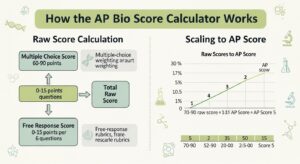
The AP Biology score calculator follows a simple process to estimate the final exam score. Students enter their raw scores from each section, and the calculator converts them into a composite score.
Step 1: Enter Multiple Choice Correct Answers
The first step is to enter the number of multiple-choice questions answered correctly. Since there is no penalty for wrong answers, only correct responses are counted.
The calculator uses this number to estimate how many points the student earned in the multiple-choice section.
Step 2: Add Free Response Scores
Next, students estimate their points for each free-response question. This estimate is usually based on official scoring guidelines or sample answer rubrics.
Students may compare their responses with released AP Biology FRQ scoring guidelines to determine how many points they likely earned.
Step 3: Calculate the Composite Score
Once both sections are entered, the calculator combines the scores into a composite score. This score represents the total raw points earned across the entire exam.
The composite score reflects the weighted contributions of both exam sections.
Step 4: Convert to the AP Score Scale
Finally, the composite score is converted into the official AP scoring scale, which ranges from 1 to 5.
Although the exact score boundaries can change slightly each year depending on exam difficulty, most calculators use historical scoring ranges to estimate the final AP score.
AP Biology Score Distribution
The final result of the AP Biology exam is reported on a scale from 1 to 5. Each score represents a different level of understanding and performance.

Score 5 – Extremely Well Qualified
A score of 5 is the highest possible result on the AP Biology exam. It indicates exceptional understanding of advanced biological concepts and strong analytical skills.
Students who achieve this score often demonstrate excellent performance in both multiple-choice and free-response sections. Many colleges award full course credit for this score.
Score 4 – Well Qualified
A 4 represents a strong understanding of the subject. Students with this score show clear mastery of most biological topics and problem-solving abilities.
Many universities accept a score of 4 for college credit or advanced placement in biology courses.
Score 3 – Qualified
A score of 3 is generally considered a passing score. It indicates that the student has a solid understanding of fundamental biology concepts.
Some colleges offer credit for a score of 3, while others may require a higher score for course placement.
Score 2 – Possibly Qualified
A 2 suggests limited understanding of the subject. Students with this score may have struggled with certain concepts or exam questions.
Most colleges do not award credit for this score.
Score 1 – No Recommendation
A score of 1 indicates that the student did not demonstrate sufficient understanding of the exam material.
This score typically means that the student may need further study before pursuing advanced biology coursework.
Estimated AP Bio Score Conversion Chart
The AP Biology score conversion chart helps students understand how raw scores translate into the final AP score.
Although the exact ranges may change each year, the conversion generally follows a similar pattern. A higher composite score leads to a higher AP score on the 1–5 scale.
Score calculators use historical data from previous AP exams to estimate these ranges. For example, a certain composite score range might correspond to a predicted score of 4 or 5 depending on the exam difficulty.
Because the exam is scaled annually, these ranges are only estimates. However, they provide a helpful guide for students trying to understand their expected results.

Why Students Use an AP Bio Score Calculator
Students use AP Biology score calculators for several practical reasons. These tools provide valuable insights into exam performance before official results are released.

Predict Exam Results Early
One of the main reasons students use a score calculator is to estimate their final AP Biology score before the official release date.
Since AP scores are typically announced several weeks after the exam, calculators allow students to get an early idea of their performance.
Identify Strengths and Weaknesses
Score calculators also help students evaluate their performance in different sections of the exam.
By comparing their estimated scores, students can identify which areas they performed well in and which topics may need improvement.
Plan College Credit Opportunities
Many colleges offer credit or advanced placement for strong AP exam scores. By predicting their results, students can determine whether their performance may qualify them for college-level biology credit.
This information can help students plan their academic schedule and future coursework.
Tips to Improve Your AP Biology Exam Score
Achieving a high score on the AP Biology exam requires strong preparation and effective study strategies. Here are some helpful tips that can improve performance.

Practice Past AP Biology Exams
Practicing with previous AP Biology exam questions helps students become familiar with the exam format and question styles.
Working through past exams also improves time management and problem-solving skills.
Focus on Core Biology Concepts
The AP Biology exam covers several important topics, including cell structure, genetics, evolution, ecology, and biological systems.
Students should focus on understanding these core concepts rather than memorizing isolated facts.
Master Free Response Strategies
Free-response questions require clear explanations and logical reasoning.
Students should practice writing structured answers that include scientific vocabulary, accurate explanations, and relevant examples.
Developing strong FRQ strategies can significantly increase the number of points earned in this section.
Limitations of an AP Bio Score Calculator
While score calculators are helpful, they are not perfectly accurate.
First, the College Board adjusts scoring each year based on exam difficulty and overall student performance. This means that exact score boundaries may vary.
Second, free-response questions are graded by human examiners, and scoring can sometimes vary slightly depending on how answers are interpreted.
Finally, score calculators rely on estimated values rather than official grading data.
For these reasons, calculators should be viewed as prediction tools rather than official score reports.

Frequently Asked Questions
What is an AP Bio Score Calculator?
An AP Bio Score Calculator is a tool that estimates your final AP Biology exam score based on your multiple-choice and free-response performance. It converts raw scores into the official AP scale from 1 to 5.
How accurate is an AP Biology score calculator?
AP Biology score calculators provide estimated results based on scoring patterns from previous exams. While they can give a close prediction, the official score may vary slightly each year.
What is a good AP Biology exam score?
A score of 3 or higher is generally considered a good score because it shows you understand the core biology concepts. Many colleges offer credit or placement for scores of 4 or 5.
How is the AP Biology exam scored?
The exam score is calculated using both the multiple-choice section and the free-response questions. These raw scores are combined and converted into the final AP score scale from 1 to 5.
When are AP Biology scores released?
AP Biology scores are typically released in early July after the exams are completed. Students can view their results through their official AP student account.
Conclusion
The AP Bio Score Calculator is a valuable tool for students who want to estimate their AP Biology exam performance before official scores are released. By entering their multiple-choice and free-response results, students can generate a predicted score on the 1–5 AP scale.
Understanding how the AP Biology scoring system works can help students evaluate their exam performance, identify areas for improvement, and plan for future academic opportunities.
While score calculators provide useful predictions, the final results are always determined by the official scoring process. Nevertheless, using an AP Bio score calculator can give students helpful insights and confidence while waiting for their official exam results.